






Artificial Intelligence in Healthcare: From Zero to Empowered

Organization
Course Specifications
About This Course
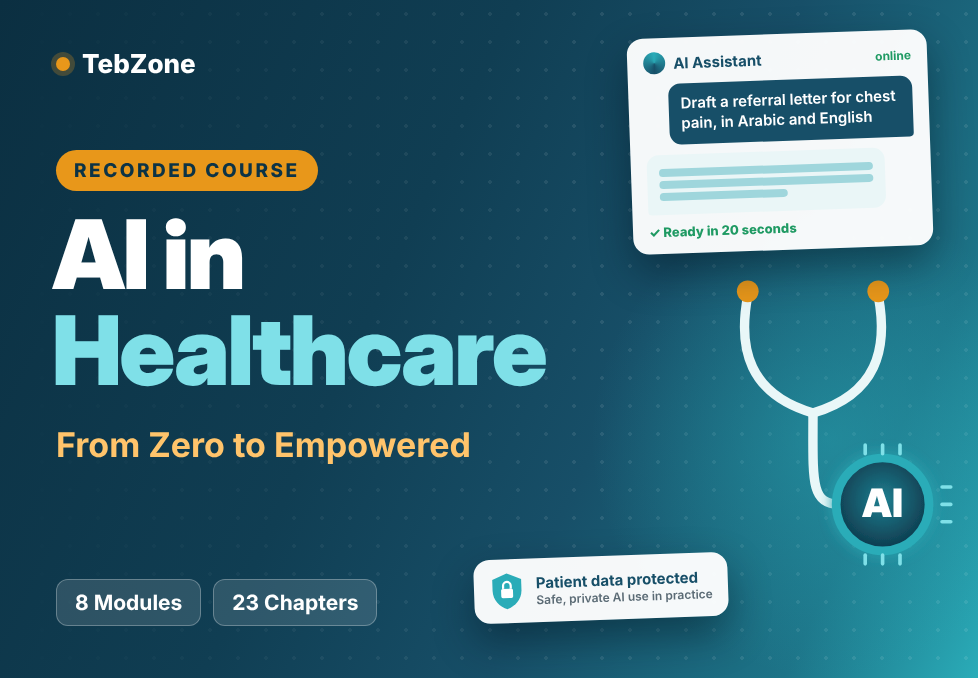
Artificial Intelligence in Healthcare
From Zero to Empowered
A recorded course for healthcare professionals in Saudi Arabia who want to use AI at work, safely.
Instructor: Youssef Hagag
AI does the paperwork, so you can be the clinician
Doctors, pharmacists and nurses spend a large part of every day on documentation and admin, and that workload is the single biggest driver of burnout. This course shows you how to hand much of it to AI tools you can open today, without putting patient data or your licence at risk.
The rules covered are the Saudi ones (PDPL, SDAIA, NDMO), and every demo uses invented or anonymized patient data. Each lesson is a short video, so you can watch one, try it, and come back for the next. A separate module shows real clinical AI platforms in use, step by step.
By the end of this course you will be able to
Yours to keep after the course
Anyone working in healthcare
Physicians, pharmacists, nurses, allied health staff, medical educators and healthcare managers in Saudi Arabia. You don't need a technical background, just a phone or a laptop.
"AI will not replace doctors. But doctors who use AI will replace doctors who don't."
The journey starts now. Not Monday. Now.
Curriculum Overview
This course includes 11 modules, 34 lessons, and 4:59 hours of materials.
The documentation burden you already live with, why AI can take it on now, and what Saudi healthcare is already doing with it
before any teaching. The same questions come back at the end so you can see how far you've come.
The full course map and the six AI words you'll hear most, with a glossary PDF to keep open while you watch.
A prompt is a brief, not a question. The director mindset and the RCTFC structure, with a vague prompt and an engineered one compared on screen.
Chain-of-thought on a synthetic case and how the techniques stack in one prompt, then role and few-shot prompting while writing a real CV on screen.
The One Rule (no real patient data in consumer AI), what counts as protected health information, hallucinations, bias, and a 6-question safety checklist.
PDPL, SDAIA, NDMO and data localization in five minutes, then do and don't scenarios from a normal working day.
What each of ChatGPT, Claude, Gemini, DeepSeek and Perplexity is best at, then ChatGPT put to the test on a synthetic case.
More ChatGPT: working inside a Project, and using ChatGPT in PowerPoint to build slides.
Claude tried on the same synthetic case, with a look at its settings, skills and usage limits.
Gemini put to the test: the synthetic case, a CV, and working with Google Docs.
Perplexity answers with sources you can click, Comet reads a PubMed paper with you, and Gemini's personal context settings.
Open-source and alternative models such as Kimi, Qwen and GLM, and how to choose between them.
Regional healthcare tools on WhatsApp: Maher ER and Areep KSA, tried on a synthetic case and a drug availability question.
Rotate tools, not accounts. A few email tricks for exploring, and an honest note on terms of service.
Medical research with cited sources, NotebookLM for asking questions of your own documents, and turning recordings into text and minutes.
Referral letters and Arabic-English translation, then MCQ banks and bilingual patient leaflets, generated and reviewed on screen.
A safe method for differentials, guideline navigation and SOAP notes. Every case is synthetic, and AI stays a thinking partner.
Admin tasks, KPI write-ups, accreditation prep and HR, in practical scenarios that mostly need no patient data.
A Custom GPT, a Gemini Gem and a Claude Artifact, one example to try for each, how they differ, and when to use which.
What an agent is, a short tour of the main agents and what they're used for, and an introduction to automation.
Formatted documents with Claude, Copilot and Gemini, designed decks with Gamma, custom medical images, and the Office AI map.
The take-home Glossary and Prompt PDFs, and how to keep up, including the course WhatsApp channel.
Prescription generator, history taking, AI clinical reports, specialist chatbots (one of them covers the Saudi drug formulary) and ready-made clinical templates.
A differential diagnosis and a clinical note drafted from a synthetic case.
Take a photo of an ECG and get rhythm, conduction and LVEF findings back.
Recording a consultation and turning it into structured notes, letters and forms.
Clinical questions answered with guideline references, tried on a synthetic emergency case.
Everyday professional tasks in Arabic with ALLaM, the Saudi national model.
Building an animated explainer video with AI, from first prompt to finished file.
Browsing ready-made assistants and skills in ChatGPT, then looking up current evidence in Glass.
Artificial Intelligence in Healthcare: From Zero to Empowered
This is our evaluation survey. kindly fill it out, thanks in advance.
Please rate the quality of the activity on a scale of 1 (poor) to 5 (Excellent)
Course Certificate
Certificates
Enroll in this course to start earning its certificates.
Course Specifications





Reply to Comment